Konrad & Allan from Archives
Download MP3This podcast is recorded in Treaty 1 Territory, the home and traditional lands of the Anishinaabe, Ininew, and Dakota peoples, and the national homeland of the Red River Metis. We acknowledge that our drinking water comes from Shoal Lake 41st nation in Treaty 3 Territory.
Narrator:We know our services and programs impact you, so let's talk about them. Together, we'll learn. Together, we'll learn. Together, we'll learn. Together, we'll learn from the people behind the scenes and get to know our city a little better.
Narrator:From the city of Winnipeg, this is Our City, Our Podcast.
Tamara:Hi, I'm Natalie. And I'm Tamara. Today, we're doing something a little different. We're gonna spend some time with a few stories shared by generations of city staff. Now some are rooted in history, some are rooted in mystery.
Natalie:Oh, and it all takes place in the iconic Carnegie Library in the Exchange District. One that's preparing to reopen to the public after years of restoration. Uniquely positioned to share the history and stories of this space are two members from Archives. Konrad Cron is the city archivist and self confessed skeptic, while Allan Nedley is the senior archivist and records manager who admits he likes a good ghost story. Konrad Allan, thank you so much for joining us.
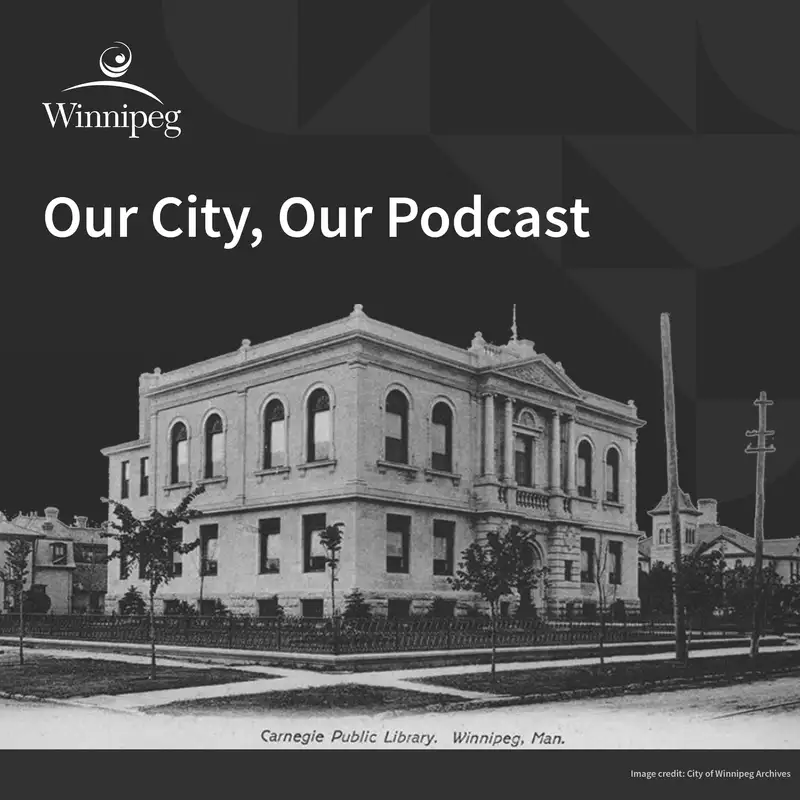
Natalie:Well, with any good story, you need to set the scene. And we're talking today about a building. It's actually just down the road here from City Hall. You go west down William Avenue, and the Carnegie Library is hard to miss. It's a carved stone building, towering columns, and it looks like it was almost designed as a kind of temple, but a temple of learning.
Natalie:You know, and in the last few years, not a lot of us have gotten inside. But Allan, you had the benefit of working there and touring people. When you were bringing people in, where did you begin?
Allan:I always like to begin in the basement because people are interested in these ghost stories and in the basement of this building, especially when it was abandoned, before we began our construction, It was very unnerving down there. There wasn't much light, lots of dark corners. You can feel something down there with you.
Natalie:And even I understand the 2nd Floor has a lot of stories attached to it.
Allan:And a lot of the stories that we collected from staff, a lot of them originated in that 2nd Floor.
Natalie:Which was the children's library.
Allan:That's where the children's section was of the library.
Natalie:Okay, wait. But before we go that way, let us explain. Konrad, for people who have walked by this building for years, maybe didn't go inside, what do they need to know about the history? What makes this building such an important part of Winnipeg's story?
Conrad:So yes, this really was a temple of learning and it was built as Winnipeg's first public library through a $75,000 grant from American philanthropist Andrew Carnegie. And at the time libraries were often private or required memberships or cost fees or simply just didn't exist. And so at this time, this library was free to all and it was relatively new. So we often take for granted that libraries are free to everyone to take out books and absorb that knowledge. But this wasn't always the case.
Conrad:So on the exterior to to note this, the exterior of the building, there is an engraving that says free to all, which spelled out the promise of this building so that, everybody, all the residents of the city of Winnipeg could freely benefit, from this resource.
Tamara:And just last year, the building marked a hundred and twenty years since it first opened, and that was October eleventh nineteen o five. How significant was that opening day?
Conrad:And the library opened to much fanfare. In attendance was, Governor General Earl Grey, also known for the Grey Cup. And he actually got the first library card, and it was card number one.
Allan:And we even know what book he borrowed. It was The Remarkable History of the Hudson's Bay Company.
Natalie:That book could certainly use a few more chapters since then. So the library opens and it quickly becomes the place in Winnipeg. It was so busy that Carnegie himself actually covered an addition to double the size in just, three years after it opened. So how much did Winnipeggers back then like to read?
Conrad:By 1910, it was the second busiest library in all of Canada, exceeding those in Toronto, Vancouver, and some of the other bigger They cities at the loaned out over 341,000 books annually to a Winnipeg population that was about 130,000 at the time. So some real avid readers here, and they really filled the need for people to get access to knowledge.
Tamara:And we'll speed read through the next few chapters of the building. The library initially closed when the branch moved to what's now Millennium Library in 1977. But residents still missed going to Carnegie, and it reopened as the William Avenue Library branch a year later until 1984. But how did the Archives actually get involved here?
Conrad:During that time, space for library services was gradually reduced, and the space was reallocated to the storage of the city's archival records. And then in 1994, it became exclusively for the records of the archives. In 1984, it was also designated a heritage building. It had protective features like the interior front rooms on both the second and first floor, the exterior facade, and also the original iron fence on the exterior.
Natalie:And despite being protected features, they all came under threat because mother nature. A rainstorm heavily damaged the building in 2013, and you all had to frantically move the archival records out as quickly as possible to a temporary location where you are still now today. But that's about to change, and a new chapter is being written for the building right now.
Conrad:As part of Winnipeg's One Fifty Commemorations, council funded the renovation of this historic building for for the archives to both honor the past, to revitalize the building to its, for its current residents, and also to give a gift to the future generations so they too could benefit from their history. So while it no longer serves as a library, when we go back to that building we still aspire to make the building free to all for those to access their history.
Tamara:And now because the building housed the City Archives for decades, you have, you know, plenty of stories to share. I wanna emphasize that it's not just one story and it's not just from one person. What we're going to get into aren't personal ghost stories. They've been shared by employees over many decades. Now Allan, why do you trust these accounts enough to preserve and tell them?
Allan:As you said, it's been preserved for many decades over many generations of staff working out of that building. So, like, the persistent nature of the stories really convinces me that there might be something here to these stories.
Natalie:Now, Konrad, during our pre interview, you described yourself as maybe the skeptic. While Allan, you seem a little more open to stories that have been passed down over the years. So how would each of you describe your relationship with what you're about to share?
Conrad:So as you said, I'm a bit more skeptical. I've heard these stories over the years and I've often been asked about it when we're giving tours in the building. But I personally had never worked in the building, so I didn't have these personal connections and I never worked alone in the building which many other staff had. So that was probably something that weighing against it. I sort of tended to think of this as, you know, an old building.
Conrad:An old building makes sounds. An old building has leaking water. It has dripping leaky toilets, banging pipes and screeching sounds. And, you know, sometimes an old building when there's a change of seasons, it might moan or creak. But these all can be reasoned away, to to some sort of building issue or something like that.
Conrad:But my approach to oral history and folklore is that there's a lot to learn from these stories. They inspire the research and inform and act as important guides. So where we need to look. And they also they provide the vital color to history. So these are often stories about real people and how they lived in a real point in time.
Conrad:And nothing does that better than oral history or folklore.
Tamara:And Allan, what about you?
Allan:Archives are a collection of memories, and we preserve the past, and we bring it to life. So perhaps these stories are just another way that we're bringing this past to life. And maybe there is some of the past alive in these buildings too.
Tamara:So what has consistently been described by staff?
Allan:The consistent things that we hear are creaking buildings, footsteps that can be easily explained maybe at this point.
Natalie:And I think that's, you know, those strange sounds, strange feelings, we can all kind of maybe recognize a moment we've experienced something like that. But Allan, maybe have something to share that goes beyond.
Allan:Yeah, definitely over the years, we've collected these stories. So, a couple of ones that I'm going to share maybe can't be explained by the building. A staff member was working at a photocopy machine. She had a long braid, typically wore her hair that way, and she felt someone lift her braid up as she was photocopying. When she turned around, nobody was there.
Allan:Another story, we have I don't you guys been in the building and in the basement, it's quite creepy down there. We have mobile shelving that you can only, that you move. There's a room in the basement that's only exposed by moving all the mobile shelving forward, and it's one of our I always show it because it's one of our creepiest parts of the whole building. So this staff member was actually down there working, had moved them all forward, for some reason was in that back room, and suddenly the shelves started to move and close on him. And nobody else was in the basement, so if he he quickly got out, but if he hadn't stayed in there, he wasn't sure how he was gonna get out of that.
Allan:And again, nobody was seen in the basement other than him.
Conrad:And part of what makes these stories somewhat believable is that they do come from different sources and people of different, you know, type of you know, think that maybe they believe different things or maybe less prone to to believing some of these ghost stories. But one instance, a former archivist did tell me that he was working alone one night on the 1st Floor and then a loud bang startled him. And then he went upstairs and he saw that there was a box, cubic foot box that had been thrown from the shelves and its contents distributed on the floor. Now this was very unlikely to happen because these boxes are very heavy, they're tightly packed, and they have lids on them. So it's very unlikely that something would fall in the first place and then spill over as well.
Conrad:And he was so disturbed by it, he threw on his jacket and ran out the door and didn't clean up the the box until the following day.
Natalie:This is someone you trust and and still work with?
Conrad:Very much so. Trust and no longer work with, but trust and believe him fully.
Allan:More than one staff member has reported seeing a woman in a white dress on the 2nd Floor and throughout the building.
Conrad:And there were lots of feelings of people suddenly something rushing out of a room when they enter the room or maybe something some blinds moving at it at odd times or or something, map tags or something kind of rustling when when, there was no breeze to be found in the in the room. So just kind of odd things like that.
Allan:We have one staff member. They were washing their hands, they took off their ring to, wash their hands. And after she washed her hands, she went to put her rings back on, and it didn't fit anymore. Then when she looked at it, it was no longer in a circle. It was actually oval shaped as if someone had crushed it or, like, squished it into that shape.
Conrad:And there were lots of occurrences where we did have an older elevator there, but the elevator wasn't supposed to move when nobody was in it. And then every now and then, they would be on one of the floors and the elevator would just the doors would just open.
Tamara:Nope. Nope. Mhmm.
Conrad:And then there there were there was one floor that was closed off to all but select staff. It was a keyed area, and the elevator needed a key to go up to that floor. And so one time when a staff member was working in that on that floor, the elevator doors opened and there was nobody in there.
Tamara:And these span over a period of time, not over a short it's over years that these And stories are
Allan:and one of the stories that really convinced me, one of our colleagues, he is not a ghost believer at all. And he told this story. And he was, you know, at first very skeptical, but staff members that he was supervising were working on a project. They had the boxes all spread out and all the materials and records. They went away for the evening, and when they came back, it had all been put away and put on a shelf.
Allan:He couldn't easily explain it, and this had shaken him. Now his belief in this really was part of the big reason why I'm swayed by these stories because he is not an individual who believes in these things.
Tamara:How did he react? Like, can you do you remember hearing those stories? Him tell that story?
Allan:Well, he was he interviewed the staff to find out who did this. Like, could this have happened? And it just wasn't possible. So he was, you know, shaken by this.
Tamara:So he, you know, as archivists, you just said, right, you're interested in the facts. He went to try to find the facts and there was nothing to support what happened.
Allan:That's right.
Tamara:How do you separate, you know, documented history which we have in the archives from folklore which grows around a building like this and leads to a conversation like we're having today?
Conrad:So historically, archivists have tended to see themselves as the handmaidens of history where we draw the source material objectively and and give it to historians and users so that they can create the history that users consume. And then in the eighties and nineties, there was a a more of an acknowledgment of the active role that archivists do play in shaping history through their selection, preservation, and privileging of certain records. So I see our role as sort of complementary to oral history and folklore so that we provide additional sources rather than any sort of objective truth or or any definitive truth. And as we see with this story, the the oral history and the folklore is is really what sparks the interest in the story in the first place. And the historical record can fill in some of those gaps and add important touch points that contribute to the stories, but the story itself is really driven and colored by the oral history.
Natalie:And to keep going with exactly that, what's really fascinating here is once you started researching, you too both found out more about a very unique family. Can you tell us about the family who lived in the basement of the Carnegie Library?
Conrad:Yes. So when we were hearing these stories, something we haven't touched on yet, when we were hearing all these stories, they all kind of had allusions to a family or a child or a tragedy or something that was kind of driving this. Everybody had a theory, and everybody knew that there was a caretaker in a family that lived there and that maybe something some sort of tragedy had befell one of the children. And so that was always kind of adding to the story and adding to the to the creepiness of the story. And so that was something that we really did wanna look into further.
Conrad:So when we looked at the archival sources in our collection, we looked at the census, we looked the provincial records, vital stats, and some newspaper archives, we were really able to fill in some of these gaps in our understanding. And we found that there was a caretaker, his name was James T. Simmons, and he lived there with his wife Florence and their four children, Jesse, Ethel, Lillian, and Llewellyn. And they lived there for nearly thirty years. And from the historical records, we found that James Simmons was born in Monmouth, Wales near Cardiff and originally settled in Winnipeg in 1882.
Conrad:He found a job as a letter carrier, which he did for four fourteen years. And he was an avid musician and contributed significantly to the music scene in Winnipeg. They lived on a in a house on McFarlane prior to living in the in the building at the Carnegie Library, and near the CPR station. So Simmons watched the building being constructed. He noted this in his application to become the caretaker.
Conrad:He walked past that building four times a day, every day. He also saw it on Sundays as he went to church at the St. Andrew's United Church across the street. And this was cited as an asset for him when he did get the job. So in the council minutes of June 1905, we learned that he was appointed as the caretaker of the Carnegie Library that year at a salary of $65 a month.
Conrad:In today's dollars, that would be $28,000 So when the Simmons family moved into the basement, the girls were aged 14, 13 and 11 and Llewellyn was born a year later in 1906. He might have been born in the building.
Natalie:And sorry, this isn't unique. It was common for folks to actually live in the library?
Conrad:Yes, yeah. It was common for caretakers to live there, especially given the hours. So from those same records we know that the hours were 09:30 a. M. To 09:30 p.
Conrad:M. Every day of the year except Dominion Day and Christmas Day. Sundays and holidays had reduced hours from 2PM to 9PM, but you can see quite busy and quite open and accessible. So there needed to be somebody there on-site to do these activities. Simmons' job as a caretaker was to make the place comfortable for their patrons, to stoke the coal furnace in the basement, to pull up the blinds, to shovel snow, maintain the building, make needed repairs, and and provide on-site security.
Conrad:So as I said, the family lived in the basement for nearly twenty eight years and they even hosted a wedding in the basement. There's an article in the in the free press during that time where there was a ceremony in which the James Simmons was the groomsman. Jesse, his daughter was a bridesmaid. So this obviously was somebody close to them. And after the ceremony, missus Simmons provided a supper.
Allan:Just wanna point out a woman in a white dress perhaps. Right?
Conrad:Yes. Maybe a wedding connection there. And so just a little bit about the living quarters. So it was a 900 square foot apartment located in the northeast corner of the basement. It featured two bedrooms, a dining room, a washroom, and a kitchen.
Conrad:And these were all on wood floors. And the apartment was next to the boiler room and a stairwell and across from the newspaper reading room.
Tamara:Prior to us recording this podcast we actually did a tour of Carnegie in the basement and the living quarters as they were there wasn't a lot of light, it was pretty dark, No windows. Like you are below ground. It's maybe not the most comfortable we'll say.
Conrad:Yes. It certainly was dark and there were a lot of tiny rooms. I imagine that it would be a great place to play or be scared because one of the things that the staff commented is that they hated going down there because they were scared of running into somebody because there were so many dark sort of corners in the room or in the in the basement that you would never hear somebody until you would be confronted with them. Then all of a sudden you would be startled. Somebody would come around a bookshelf or come around a corner and surprise you.
Conrad:So quite startling. But I also imagine that it was a nice place to grow up.
Allan:Yeah, because so we can imagine that kids may be having to run a library after hours, maybe reading books or playing hide and seek in that giant building. There's lots of places to hide. So, for a child or, you know, for kids, that could be an amazing place to Yeah, grow
Conrad:with access to all the children's books you can find in a city and maybe reading to their younger brother or just exploring the books or just having quiet time in a library by themselves.
Natalie:On the Main Floor it's a dream, but maybe in the basement. I don't know, a bit of a nightmare. There's also more to share about a daughter.
Conrad:Yes. So at first this sounds pretty idyllic. We're wondering where the tragedy is. Where where where is this the origin story of this ghost, if there is one. And the records show, you know, through 1915, the three daughters were alive and well, and they found good jobs at Eaton's.
Conrad:You know, they would probably walk there, go out the back door, which was a private entrance and walk towards the Eaton store where they made I will say the census shows that they made more money than their father did. So they stayed there and they lived there. They continued to be involved in the church activities. Little Jesse was 18 in 1915 and was the leader of the junior congregation at Saint Andrew's United Church. So quite active there.
Conrad:And the family continued to live there into the twenties. And the young women even started paying rent once they once they started their jobs at at the Eaton store. So everything seems great up until 1923 and '24. What we found there is that Ethel, the second daughter suddenly became gravely ill. She was rushed to the hospital where she later died.
Conrad:Now this wasn't the the tragic origin story we'd kind of thought with a young child. She was 31. So not your typical ghost origin story, but still tragic and incredible loss for the family.
Natalie:And from what you can read, we know or do we understand what made her ill and how this ended so tragically?
Conrad:We don't unfortunately but we do know around that time there were a lot of infectious diseases that were present pneumonia, influenza, tuberculosis, heart disease, kidney disease. And so mortality was high for younger folks in that time period. So it could be any of those things. But at least we know it was nothing accidental or nefarious or or there's a criminal even.
Allan:So when you put all these stories together, we kind of maybe see some connections. So, again, the woman in the white dress, perhaps that wedding, right? That misshapen ring, that could also be some connection with the wedding or lost love. The movement of blinds that staff reported, maybe kids running their fingers along the walls, running around playing. Creepy basement as a former residence down there.
Allan:The cleaning up of the archival project, maybe that connection with the caretakers maybe. And then this death of Ethel at 31, perhaps the source of all this unexplained activity.
Natalie:To pull it back to what you can read and assess, I do want to add one last thing, that is with the Simmons family. You haven't made a touch point there, have you?
Conrad:No, so just to wrap up their stories, we know that James stayed in the building until 1934 when he retired with his family and he moved to a house on Furbie Street. And then five years later Florence died in 1941. And we don't know much about what happened to their children except we do know that Lillian or Gwen or Gweny as she was known worked for Eton's for over forty years. She died in 1979 buried in Brookside Cemetery along with her father and mother. And Llewellyn, we do know that he went on to become a postmaster in Dauphin and Brandon in the nineteen fifties and then he died in 1980.
Conrad:But beyond that, we don't have a connection to the family. But we do feel like we've gotten to know the family a little bit now that we've done some of this research and looked at their lives a little bit.
Natalie:And if anyone's listening and happens to know any of this family, reach out.
Tamara:So Konrad, let's get back to the fact that you said you're a skeptic. You said you feel like you know this family. You spent time researching these stories.
Narrator:Has your mind been changed yet?
Conrad:Although I remain skeptical, I'll grant that maybe Ethel's spirit stayed in the library, after her passing, and maybe this is not a tragic or a vengeful haunting, but rather it's just a presence of choice. Somebody or a spirit maybe revisiting a place that had happy memories and a well a life well lived. And so what the records don't tell us is whether she had a playful sense of humor or something that would lead her spirit to to play some tricks on future visitors here. But we're hoping that she's at peace with what we've done to restore the building, to return it to something that would be more familiar with her, and especially buzzing with activity.
Natalie:And Allan, maybe a a last stop on the ghost stories with you. Is there any final element that you wanna share that that really does kinda make you stop in your tracks and and wonder if there might actually be something to it?
Allan:Just the nature of so many different staff people telling us about these stories. And in Winnipeg, we're not even the first archives that has this kind of paranormal feelings. The archives in Manitoba, our provincial archives, has very similar stories with their vaults. So perhaps it's something about the records or our purpose for collecting all these records, right? Think there might be some something there to it all.
Tamara:So whether people believe in ghosts or not, I think everyone can appreciate just the incredible history both outside the building and inside. Restoration is nearing completion. We like we mentioned, we toured it and crews are very busy working towards an opening next year. Tell us what people can look forward to once those doors are finally open again to the public.
Conrad:So as you said, we're we're well into construction now. We do still have another twelve to fifteen months left to go on it, but the physical restoration is going really well. Structural work has been completed, to ensure that the records can be stored there. Work has started on restoring some of those beautiful heritage elements, the columns, the decorative moldings and the fencing. And work is also underway to provide that state of the art climate controlled vault to preserve and protect our records into the future.
Conrad:And work will soon begin on the public facing of the building, the multipurpose room, the research room, and the reception area. So when we open in hopefully late twenty twenty seven, visitors can expect a warm and welcoming environment. I'm sure Ethel will be there to to support that. And a space for public research and for programming and a a climate controlled vault that will ensure that we protect our documented heritage for years to come. So we're very much looking forward to welcoming all visitors there in 2027.
Tamara:Earlier, you said maybe some of the things could be explained by maybe a drafty old building. It's going under some renovations. It won't be hopefully drafty anymore, airtight. How are you gonna explain any sort of unexplainables going forward?
Conrad:That might put me in Allan's camp where I start to believe more of the ghost side of these stories.
Natalie:Be careful who you invite in.
Tamara:There's a lot of people getting up close and personal with that building right now. Have they encountered anything or found anything that maybe kind of speaks to some of this lore?
Allan:Yeah, well our construction crews actually found bones when they were excavating the area. Now it's not the bones you might think. After an investigation, they were shown to be horse bones and they actually had pretty clean cuts across the bones. So maybe they were butchered. I'm not sure how they ended up in the soil around the building, but that was an interesting find though.
Natalie:Like I imagine the day that those bones were found that must have stopped construction for a moment.
Conrad:Yeah, the construction stopped immediately and the Winnipeg Police Service was called investigate and they did did assess those bones fairly quickly. So thankfully over a couple of days we were able to figure out that these were equine bones and not human bones or any other remains that we should be concerned about.
Tamara:Anything else maybe from an archival perspective found in the building?
Conrad:Well as they were cleaning out the building you know as you know in 2013 the archives had to decant the building really quickly and so some things were left behind. So they did find some pretty neat artifacts like they found a an dispenser probably from World War one where they would have it's a it's a cylinder that's metal and they would have put rags or or some sort of ether sort of material soaked material in there and somebody would have inhaled it through a straw. And so we did find that and we found some measuring devices of of various sorts like electrical or maybe vibration that we didn't recognize.
Natalie:These are strange items for a library though, no?
Conrad:Yes. So as we were the repository for the city's records for, you know, thirty plus years there, sometimes things ended up there that maybe from different departments or maybe just somebody so they people knew that this is where we store sold older materials that they deposited there. So not sure how they had any relevance to to the city, but we did wind up with a lot of neat neat stuff.
Tamara:One last question for you both here and it's something we ask everybody. What's something about Winnipeg that you wish everybody knew and it could be work related, not? Konrad let's start with you.
Conrad:Well it's not one thing but I wish everybody knew a little bit more about the city's history and how much it contributes to who we are today. There are literally thousands of stories with direct connections to us today, and I wish more people knew about it. So for example, the massive and ambitious 1972 unicity amalgamation where 13 municipalities and local governments got together to join to become one big city with a motto of one with the strength of many. And so overnight, Winnipeg doubled its population, expanded its councilors from 18 to 50 members, established the community committees that we still see today to ensure representation for the communities. It coordinated central services like public works, water and waste, fire, police, ambulance.
Conrad:And the effects of this can be seen in many ways today, you know, whether it's the bridges that connect communities, the parks that we enjoy, the sense of identity that we still see, the enduring sense of identity in many of these communities, they originate in those original communities. And it's something that I wish more people knew about because it does impact their lives on a daily basis and and it contributes to who they are as Winnipeggers.
Tamara:And there's a lot in the archives on that. Allan, a different approach for you. What do you want Ethel to know about Winnipeg today if she's listening?
Allan:Winnipeg's known for this rich collection of records and history that we're able to access to explore stories like Ethel's. And here we are talking about Ethel Simmons today. Right? That wouldn't be possible if we don't have these records preserved, the stories preserved. We have a lot of archival institutions in our city, which the City, Winnipeg Archives is known as one of the best municipal collections in Canada.
Conrad:And I will say, you know Ethel, if if you're listening, your life mattered, and I think all, like, Winnipegger's lives matter. And sometimes it just takes a little bit of digging to to dig into that a little bit to see that there these are real people and identities and with worthy stories. Everybody's got a story to share, and and we're happy to share Ethel and the Simmons family story today.
Tamara:That's lovely.
Allan:Free to all.
Narrator:Free to all.
Tamara:Thank you. Okay. Let's turn the lights back on everyone. In addition to it being spooky season, it's also election season. Winnipeggers are going to the polls through October.
Tamara:Advance voting runs until October 23 with election day, Wednesday, October 28. Circle that date on your calendar and get out and vote if you're eligible.
Natalie:And coming up on the next episode of our City, Our Podcast. Konrad, you talked about everyone having an important story and, that's often very important when it comes to public engagement. We're gonna talk to our manager of public engagement as that office, looks at ten years since its beginning, and it's made
Tamara:a lot of progress. It's wonderful to hear. It's gonna be a good conversation. If you have any questions, comments, or topics you want us to look into, please let us know. Email us, city-podcast@Winnipeg.ca.
Tamara:Happy Halloween.